
Honda Ignition Repair Jacksonville: Key Won't Turn Fix
Need help with this problem? Call (904) 515-9573 or request a callback to discuss your vehicle. See ignition repair in Jacksonville for what the visit covers.
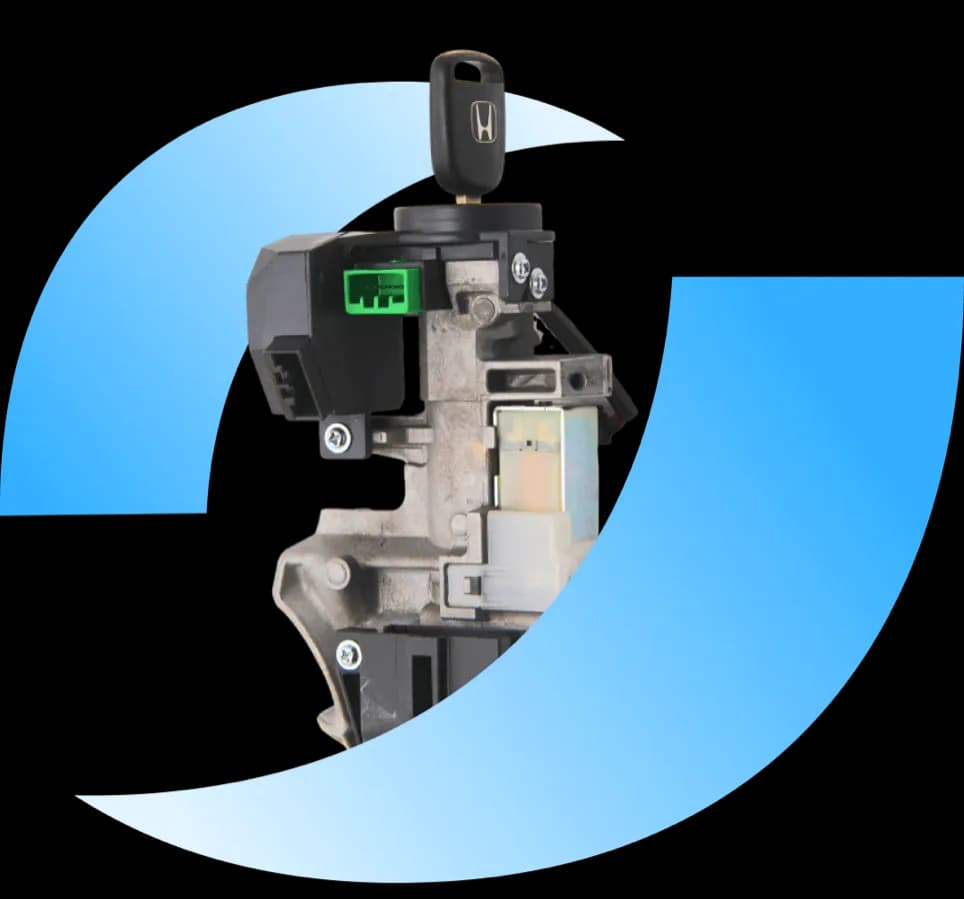
If your Honda key slides into the ignition and stops dead, or turns without starting the engine, the first step is separating a mechanical lock fault from an electrical switch fault. On 2003–2015 Honda Accord, Civic, CR-V, Element, Odyssey, Pilot, and Fit models, a key that will not turn is almost always caused by worn split wafers inside the ignition lock cylinder catching on the sidewinder key track. We rebuild or replace Honda ignition cylinders and electrical switches at your vehicle across Jacksonville and Duval County, matching the cylinder to the key you already carry so you do not end up with separate door and ignition keys.
| Symptom at the key | Primary suspect | Typical mobile service check |
|---|---|---|
| Key slides in but refuses to turn (wheel not binding) | Mechanical lock cylinder (worn split wafers or worn key track) | Inspect key blade wear, pull cylinder, and re-wafer or replace housing to match existing key |
| Key turns normally, dash flickers or engine stalls when released | Electrical ignition switch behind the column | Test run/start voltage at the switch harness and replace the electrical contact block |
| Key turns, engine cranks or cuts out with blinking green key light | Immobilizer / transponder recognition circuit | Check spare key behavior, transponder ring reading, and vehicle indicator status |
| Key blade twisted or snapped off inside the keyway | Broken key fragment + binding wafer pack | Perform broken-key extraction first, then inspect wafers before reassembly |
Why a Honda key stops turning: the split-wafer design
Two parts wear down together on a high-mileage Honda: the laser-cut key blade and the brass split wafers inside the lock cylinder. Every time you insert and turn the key, its milled side tracks lift a row of paired half-wafers to an exact shear line. After ten or fifteen years and thousands of starts, the soft brass tips round off and develop burrs. The key still slides in, but one deformed wafer hangs up a fraction of a millimeter below the shear line and locks the core solid.
Do not force a key that binds or put pliers on the head. If your owner's manual describes a steering-lock release check, use only gentle left-right wheel pressure with the vehicle safely in Park. Forcing the blade twists the metal or shears the tiny wafer springs inside the cylinder, turning a straightforward wafer rebuild into a full housing replacement.
Rebuilding the Honda cylinder vs. replacing the whole assembly
A dealership typically quotes a complete steering-column lock assembly that comes pre-coded to a brand-new mechanical key cut. Unless every door and trunk cylinder is rekeyed at the same time, you end up carrying two different keys: one for the door lock and another for the ignition.
Our mobile technicians pull the cylinder core, strip out the bent split wafers and worn springs, clean the tumbler chambers, and build the cylinder back up with fresh Honda-spec wafers matched to your original factory key code. If your daily key blade is worn smooth along the track, putting a bad key back into fresh wafers will chew them up again, so we check key wear on the spot before reassembling the column. Compare both approaches in our guide to ignition-cylinder replacement versus repair.
Cylinder vs. electrical switch: two separate parts on the column
The ignition lock cylinder is the mechanical barrel at the right side of the column. The electrical ignition switch bolts to the opposite left end of the housing and routes battery power to the accessory, run, and starter circuits. Replacing a mechanical cylinder does nothing for a pitted electrical switch, and replacing a switch will not free a jammed key.
When a Honda switch wears out, its internal copper contacts pit and overheat. That usually shows up as an intermittent no-crank, dash gauges that drop out over bumps, or an engine that starts and immediately dies as the key returns from Start to Run. We test voltage drop at the switch connector with a meter before quoting parts. See our ignition-switch failure symptom guide for what to note before calling.
What we see on Civic, Accord, CR-V, Odyssey, and Pilot
Civic and Accord (2003–2015)
Eighth- and ninth-generation Civics and seventh- and eighth-generation Accords account for the majority of our stuck-key calls in Jacksonville. The key often gives a week or two of warning by catching between OFF and ACC before it finally refuses to rotate in a parking lot.
CR-V, Element, and Fit
On a CR-V, Element, or Fit, tell us the model year, whether it uses a keyed ignition or push-button start, and whether a spare key behaves any differently. Work vehicles and beach cruisers often collect sand or dry lubricant buildup in the shutter door, which accelerates wafer wear.
Odyssey and Pilot
On Odyssey minivans and Pilot SUVs, a stuck key can involve either the split wafers or the shift-interlock solenoid when the key will not rotate all the way back to OFF to release from the ignition. Note whether the gear indicator sits cleanly in Park and whether the key stops going in or coming out.
The Honda immobilizer indicator and transponder checks
Honda's official instrument-panel indicator guide explains that a blinking green key icon on the dash points to a key-recognition issue in the immobilizer system. Always check the owner's manual for your exact model year. Because a mechanical cylinder rebuild retains your original key head and transponder chip, immobilizer reprogramming is rarely needed when only the wafers are rebuilt.
How to tell it is the ignition before you call
- Key will not turn at all: check whether the steering wheel is pressed hard against the column lock stop and whether a spare key turns any easier. See why a car key won't turn in the ignition.
- Key turns freely, no crank: observe whether the dash lights stay bright or black out when the key moves to Start.
- Key turns and cranks, will not stay running: watch the green immobilizer key icon on the instrument cluster.
- Key is stuck in ACC and won't come out: confirm the shifter is firmly in Park and the battery has charge.
Call (904) 515-9573 with your Honda's year, model, symptom, and location in Jacksonville, Orange Park, or the Beaches. We confirm mobile availability and provide a preliminary phone estimate, then confirm the final price after on-site inspection before work begins.